CPR became mandatory for cables across the EU/EEA from 1 July 2017 (CE marking against a DoP). Following EU exit, the position in Great Britain has changed and is still reforming:
Practical effect for a specifier: accept either a CE- or a UKCA-marked DoP in GB, and confirm the declared Euroclass on the DoP – not just the marketing datasheet. The framework is under active reform (Construction Products Reform White Paper, February 2026), so re-check before relying on it for a submission.
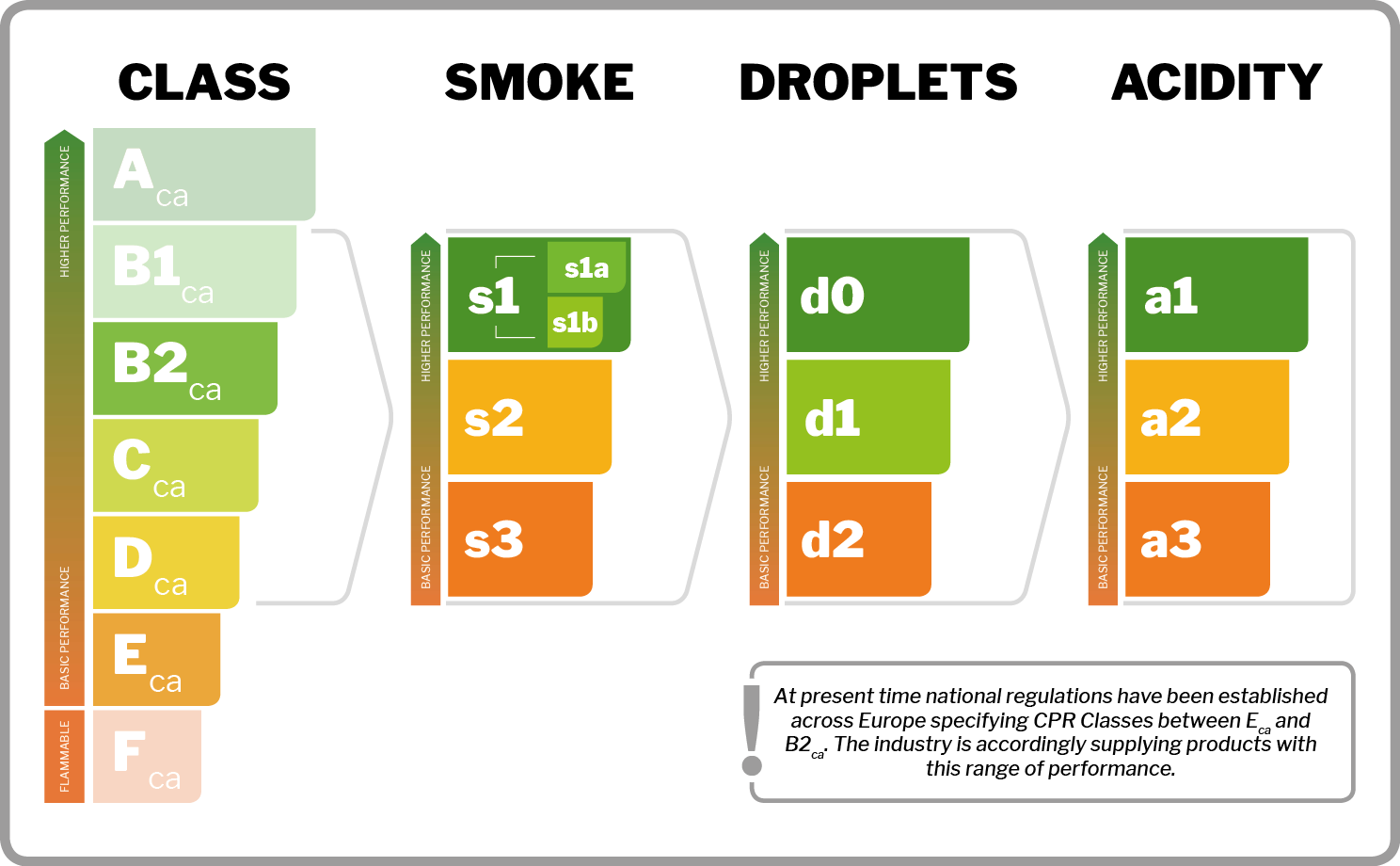
The Construction Products Regulation (CPR) states how power, control and communication cables permanently installed in buildings are classified for their reaction to fire. Under the harmonised standard BS EN 50575, the manufacturer declares the cable’s performance in a Declaration of Performance (DoP) and marks it accordingly; the reaction-to-fire class itself is assigned using BS EN 13501-6. This guide explains the Euroclass hierarchy (Aca–Fca), the smoke, flaming-droplet and acidity modifiers, and what to specify for UK installations – and the marking position in Great Britain since Brexit.
Although both use similar notation (B, C, D, etc.), they involve different test methods. For example, B2ca for cables is not the same as B for wall linings, but both imply strong fire performance.
| Class | Plain-English meaning (short) | Typical notes |
|---|---|---|
| Aca | No contribution to fire (effectively non-combustible) | Rare for cables |
| B1ca | Very limited contribution to fire | Stricter than B2ca |
| B2ca | Limited contribution to fire | Common high-spec class; tested incl. EN 50399 |
| Cca | Controlled contribution to fire | Tested incl. EN 50399 |
| Dca | Acceptable basic performance | Lower than Cca; limited flame spread |
| Eca | Basic flame propagation pass only | Entry level |
| Fca | No performance determined / fail Eca | Avoid for escape routes |
Higher up the list = better fire performance (Aca → B1ca → B2ca → Cca → …).
You’ll often see a full designation like B2ca-s1a,d1,a1.
| Suffix | What it controls | Options (best → worst) | Plain-English meaning |
|---|---|---|---|
| s | Smoke production | s1a, s1b, s2, s3 | s1a = very low smoke; s1b = low smoke; s2 = moderate; s3 = no limit |
| d | Flaming droplets/particles | d0, d1, d2 | d0 = none; d1 = none persisting >10 s; d2 = no requirement |
| a | Acidity/corrosivity of gases | a1, a2, a3 | a1 = very low; a2 = limited; a3 = no requirement |
Within the UK, BS 7671:2018+A2:2022 ties into CPR at Regulation 527.1.3, which requires cables to satisfy the CPR in respect of their reaction to fire. Where Regulation 422 determines that cables need improved fire performance but are not covered by Regs 422.2–422.6, this “may be achieved by using cables with a minimum light transmittance of 60 % when tested in accordance with BS EN 61034-2” together with limited flame propagation to the BS EN 60332-3 series. Note this is a BS 7671 performance path – it is not phrased as an across-the-board Euroclass minimum.
Minimum: Cca-s1b,d1,a2:
Note: Great Britain does not set a statutory minimum Euroclass for general building cables (unlike some EU member states). The classes below are recommended good practice and specifier/risk-driven — confirm the required class against the project fire strategy, BS 7671 and any client or insurer specification.
Preferred: B2ca-s1a,d1,a1
A CPR Euroclass measures a cable’s contribution to a fire (flame spread, heat release, smoke, droplets, acidity) — not its ability to keep working in a fire. The two are separate properties, assessed under different standards:
BS EN 50575 itself excludes cables for “safety installations such as alarm, way guidance and fire fighting installations” from its scope. So a fire-resistant cable such as Prysmian FP600S has both a Euroclass (e.g. B2ca-s1a,d1,a1) and, separately, its fire-survival rating. Never specify a high Euroclass expecting circuit integrity –
Prysmian FP600S (BS 7846-F120) meets the latest CPR Euroclass rating:
If, for some reason, FP600S is not suitable (cost, availability, or otherwise), you can look at alternative BS 7846-F120 or fire-rated SWA cables from other manufacturers – many now offer B2ca–s1,d1 (or s1a,d1) ratings. Examples include:
Always confirm with the manufacturer’s datasheet or DoP (Declaration of Performance) that the specific drum/batch of cable has the required CPR rating.
CPR reaction-to-fire classification is one piece of a compliant cable specification. These companion guides cover the fire-resistance, containment and life-safety supply requirements that sit alongside it:
Specifying cables for a protected escape route or life-safety circuit? Read our companion guide, Wiring in Protected Escape Route, for the fire-resistance and containment requirements that sit alongside CPR classification.
Main image downloaded from: https://cpr.europacable.eu/ Accessed: 2025-06-04